
The Quarter Hour Methodology: A Disciplined Framework for Economic Mobility and Digital Equity
Quarter Hour is a Virginia nonprofit corporation incorporated in 2026 to serve refugees, displaced people, conflict-affected communities, immigrants, and underserved populations in the United States and internationally, including Black, Indigenous, and People of Color (BIPOC) communities in our US work. What sets our approach apart is not a single tool or curriculum, but our operating methodology: a disciplined, modular framework built to fit the realities of marginalized lives while building durable economic and digital agency.
The Problem We Answer
Deep poverty and systemic exclusion are not temporary emergencies. They are persistent conditions shaped by fragmented time, unstable income, and institutions that demand long, unbroken hours from the people with the fewest hours to spare. Quarter Hour answers with a different operating discipline: support structured to fit real lives, in units small enough to complete and consistent enough to compound.
Quarter Hour is a nonprofit corporation incorporated in Virginia, United States, in 2026. We build programs for immigrants and newcomers, refugees, asylees and asylum seekers, internally displaced people, diaspora and host communities, people facing economic marginalization, and BIPOC communities in our United States work. What sets the organization apart is its operating methodology: a structured approach built around how adults with fragmented time and high daily pressure actually build durable capability. Within the Economic Mobility lane, this methodology powers Prosperity Graduation, our flagship application for durable household advancement.
The Unit and the Loop
Small actions practiced inside real daily life.
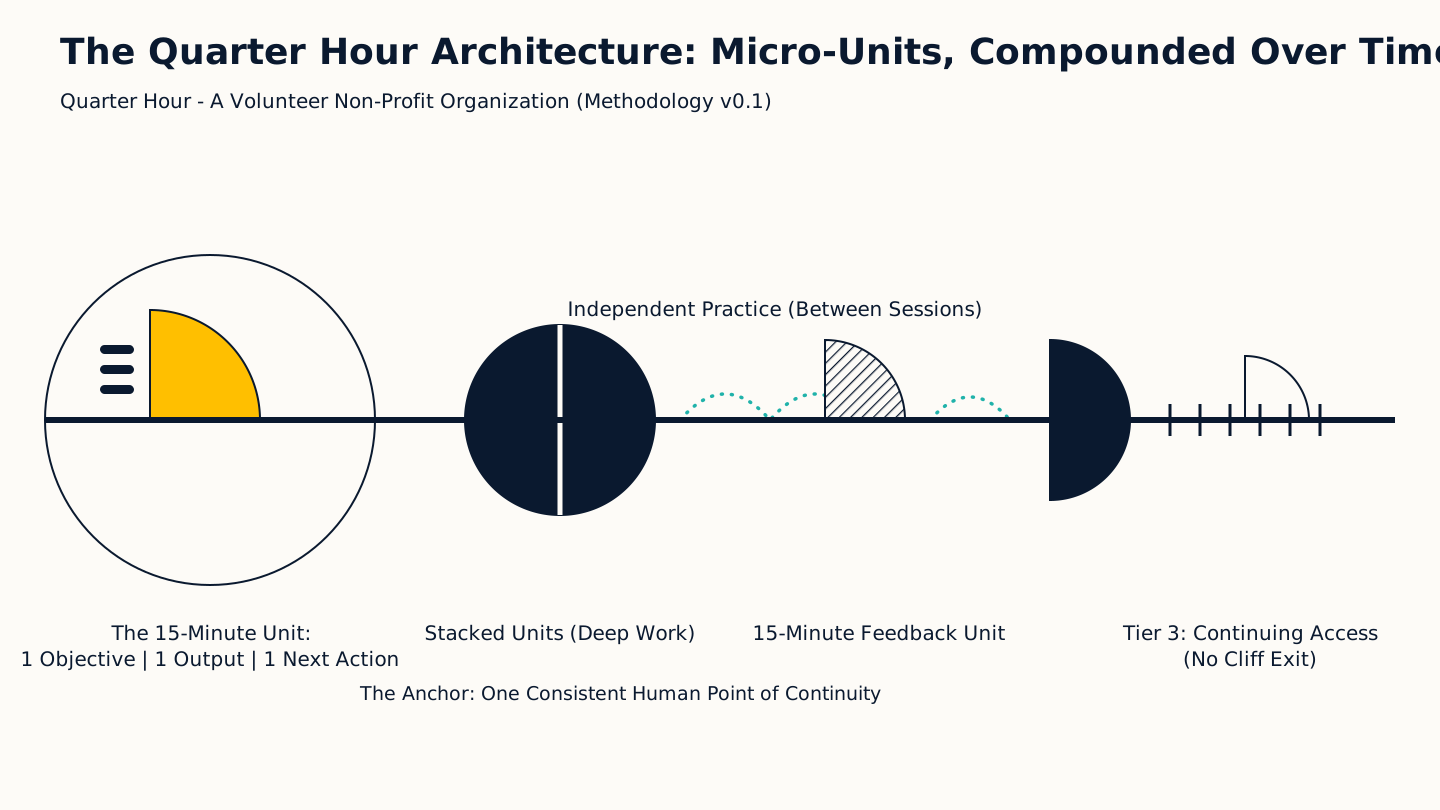
Many people facing displacement or economic precarity do not lack ambition; they lack unbroken hours. Our methodology treats the 15-minute block, the Quarter Hour, as the basic unit of program architecture. Every unit is built to fit into a crowded day and requires three things: one clear objective, one tangible output, and one defined next action.
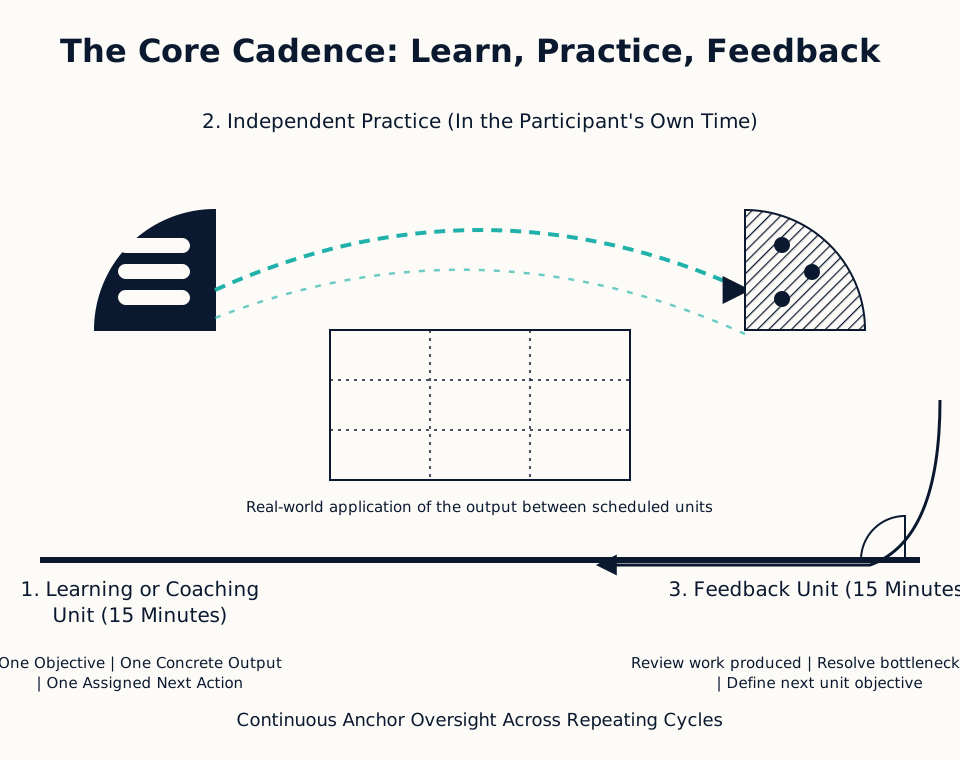
A single unit never stands alone. It sits inside a three-part learning loop: a focused 15-minute coaching or learning session, followed by independent practice in the participant's own time, and completed by structured feedback before the next step. Respecting household time-use constraints, the fifteen-minute session introduces a single tool, and the days between sessions become the space where that tool is tested in real life. The feedback then sharpens it, but independent practice is where real progress happens. By designing around small, repeatable cycles rather than long classroom seat-time, the protocol respects adult commitments while building verified momentum.
Stacked Quarter Hours and the Consistent Anchor
Steady human support that builds lasting habits.
When a task demands deeper work, such as drafting a business plan, preparing for a licensing exam, or navigating a complex digital tool, we do not switch to an open-ended lecture format. Instead, the methodology stacks multiple Quarter Hours back to back. A one-hour workshop is simply four distinct 15-minute units in sequence, each preserving its own objective, tangible output, and brief transition. If life interrupts a participant mid-session, they keep the outputs already completed and know exactly which 15-minute block to resume next.
Throughout their journey, each participant works with one consistent anchor person. Specialists, mentors, and technical instructors may step in for specific stacked units, but the anchor holds the thread of continuity, tracks the learning loops, and ensures no one gets lost between handoffs.
The Three Tiers: A Framework Without a Cliff
Our methodology organizes participation into three connected tiers so that support adjusts to life circumstances without sudden drop-offs:
- Tier 1: Stabilization and Referral. Immediate triage, navigation, and warm handoffs to trusted partner services when urgent basic needs block learning.
- Tier 2: Core Cadence. Active participation in regular Quarter Hour loops and stacked sessions toward defined capability and livelihood goals.
- Tier 3: Continuing Alumni Support. Lighter-touch check-ins, peer networks, and refresher units. There is no cliff exit when a core track ends.
The Five Strategic Lanes
The methodology serves as the shared operating spine across all five of Quarter Hour's strategic lanes:
- SG1: Access and Capability. Foundational digital, administrative, and navigational skills for daily life and self-advocacy.
- SG2: Economic Mobility. Livelihood pathways, income generation, and dignified work transitions.
- SG3: Algorithmic Inclusion and Community Voice. Ensuring underserved languages and communities are represented fairly in emerging technologies.
- SG4: Language, Heritage, and Culture. Preserving mother tongues, cultural continuity, and intergenerational connection.
- SG5: A Trustworthy Institution. Governance, safeguarding, data stewardship, and operational accountability.
Prosperity Graduation
Within our Economic Mobility lane (SG2), our flagship protocol is Prosperity Graduation, Quarter Hour's adaptation of BRAC's Graduation Approach. Rather than pushing every participant toward small retail self-employment, the model places three coequal pathways side by side: reskilling for new sectors, upskilling within existing trades, and entrepreneurship. In every pathway, real market pull is verified before productive assets or training grants are committed. In our United States adaptation, the protocol requires formal benefits-cliff clearance with a certified benefits counselor before any asset transfer or cash grant occurs, protecting families from losing essential healthcare, childcare, or food assistance. This adaptation addresses an empirical gap in the United States context through disciplined field evaluation.
Our Evidence Discipline and Stage Sequence
We separate what we track into four strict levels of claim: activity, output, participant change, and verified impact. Elements of our methodology draw on established global research, and we govern our work through three stages: internal pilots first, a shared learning network second, and external training or certification only after independent verification.
This page offers an overview of our operating architecture. The complete methodology document is held internally by the organization; prospective partners, researchers, and funders may request the full methodology document through our contact page.
---